How Cradle of English is bringing historic London to life in 3D
One medieval hall today, hundreds of sites within reach. How Teleport's automatic 3D Gaussian Splatting reconstruction unlocks digital heritage capture at scale.
Sebastian Grigore
Cradle of English worked with Teleport to reconstruct the London Guildhall automatically, turning more than 100GB of photographs into a high-fidelity 3D model in under a day, and proved that a pathway exists to capture a whole city's heritage at scale.
That is no small project. London carries two thousand years of recorded history, and thousands of its buildings and artifacts are still standing. Capturing even a fraction of them in 3D is an enormous undertaking, larger still if England's record is ever going to connect with the rest of Europe's.
A hall that has watched over London for six centuries
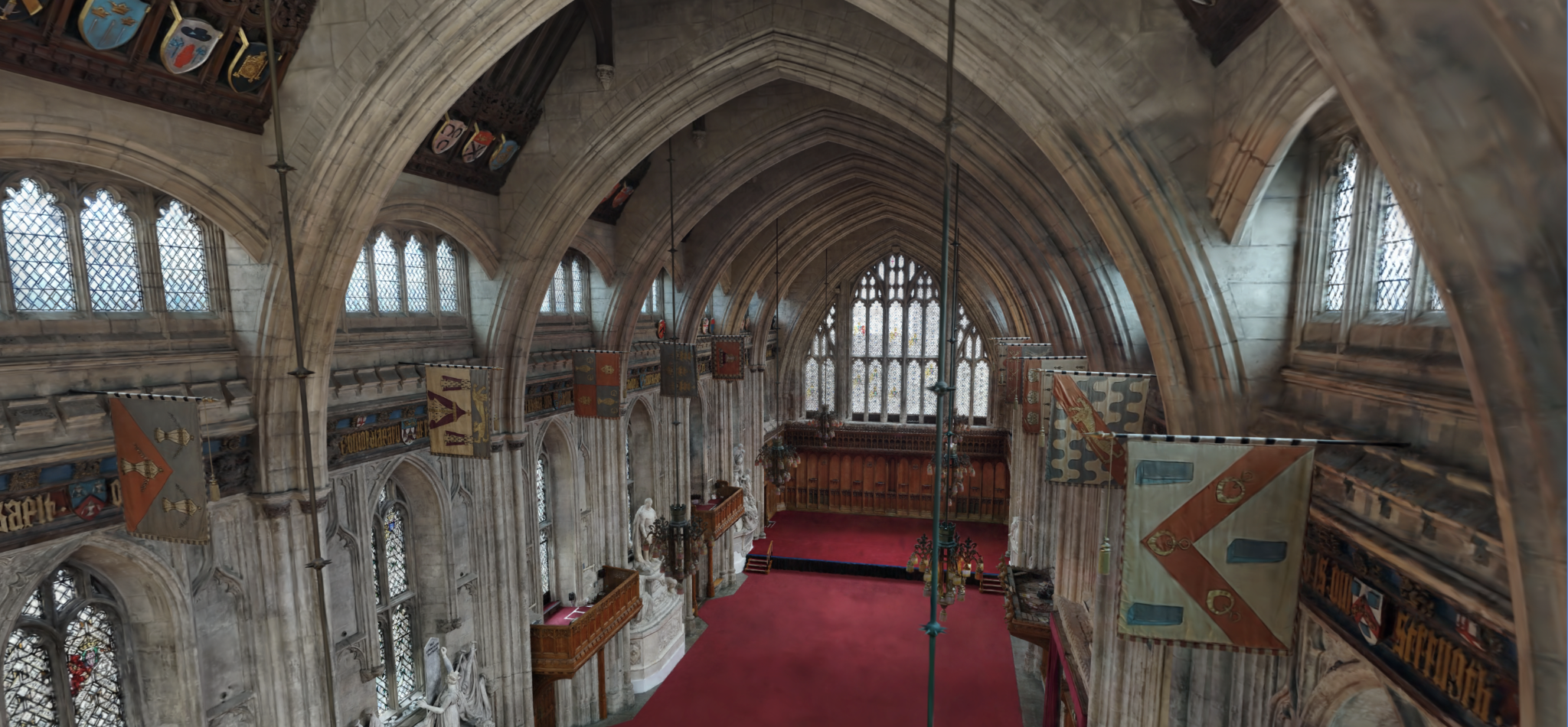
Step into the Great Hall of the London Guildhall and you're standing in one of the last great medieval rooms in the city. The hall you see today was built between 1411 and 1440, on a site that has held a civic hall since the 12th century. It has outlasted the Great Fire and the Blitz. Beneath its vast Gothic roof, monuments line the walls, banners hang overhead, and light falls across stone that has framed six centuries of London life.
It is exactly the kind of place Cradle of English exists to bring to the world. Their work is about telling stories, placing people inside the continuum of history wherever they happen to be, and they treat 3D capture not as the finish line but as the raw material for something richer: immersive, explorable experiences that let anyone walk through a space they'd otherwise never reach.
Something else surfaced during the scanning, whispering in the stones as the years ticked by. It lies in what the Guildhall represents, as a centre of administration and city management second but as a repository of sacred memories first and foremost. Sacred memories in the sense of being recollections and reflections of the special moments which, together, define the collective memory of a country discovering itself, shaping its commitment to the future from its memorial of special moments, and people, from its past.
The London Guildhall was their first project with Teleport. It would also become the proof that their far bigger ambition, a living digital record of historic London, is genuinely buildable.
The craft is in the capture. The grind was in the reconstruction.
Deciding which pieces of history are worth saving, choosing which sites to prioritize, and recording a space faithfully is demanding, skilled work, whether that is done with handheld cameras, 360 rigs, or a drone in the air. It is also the rewarding part, the reason Cradle of English does what it does.
The Guildhall is a case in point. To document the Great Hall, the team flew a single drone through the interior, up toward a roof that rises nearly 90 feet (about 27 metres) overhead, to reach the vaulting, the tops of the monuments, and the detail no camera at floor level could ever see. The result was roughly 4,000 to 5,000 high-resolution photographs: more than 100GB of data for a single room.
The part that has never been rewarding comes next. Turning thousands of photos into a clean, high-fidelity 3D model has traditionally meant wrestling with reconstruction software on a local machine: tuning parameters, babysitting jobs, watching a capture fail overnight, and starting over with a GPU tied up for a day or more each attempt. Do it once and it's a slog. Do it across a hundred sites and it's simply not possible.
For an organization whose value lies in curation and storytelling, every hour spent coaxing a reconstruction to finish is an hour not spent finding the next site or shaping the experience visitors will remember.
High fidelity, fully automatic
Teleport removed that entire step.
Cradle of English uploaded the photographs, more than 100GB of them, and Teleport's cloud pipeline handled the reconstruction from end to end. No parameter tuning. No local GPU. No overnight retries. For this capture the team trained at 5,000-pixel resolution, letting the pipeline work from the full detail in the source images.
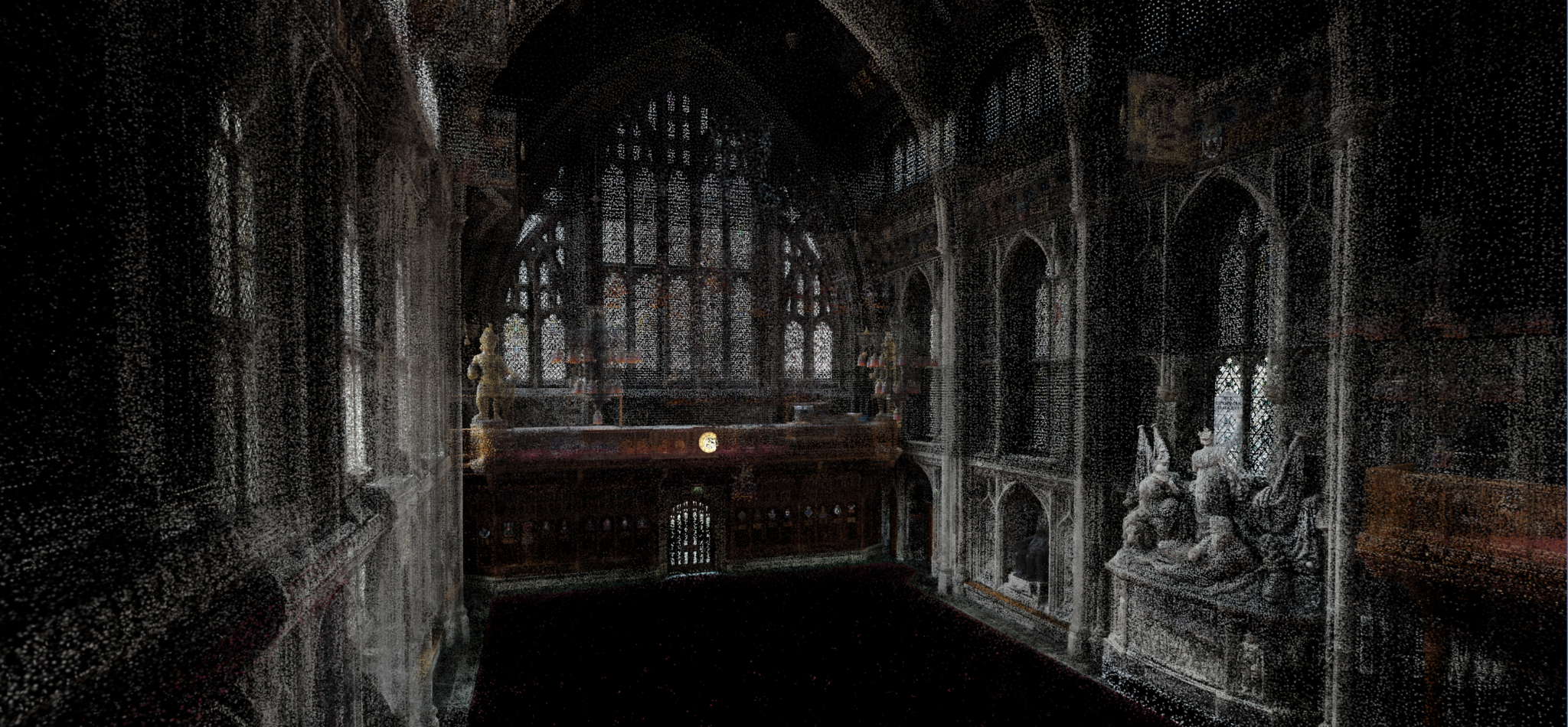
In under 24 hours, the platform returned a high-fidelity 3D Gaussian Splat reconstruction of the Great Hall, up to 10 million splats, faithful down to the carved monuments, the vaulted ceiling, and the play of light across the walls.
"Having managed Guildhall 3D's production since inception, it's gratifying to see our data transformed into a high-fidelity Gaussian Splat with zero technical lift. Hands-free, scalable cloud processing opens huge possibilities for heritage documentation." — Thomas Flynn
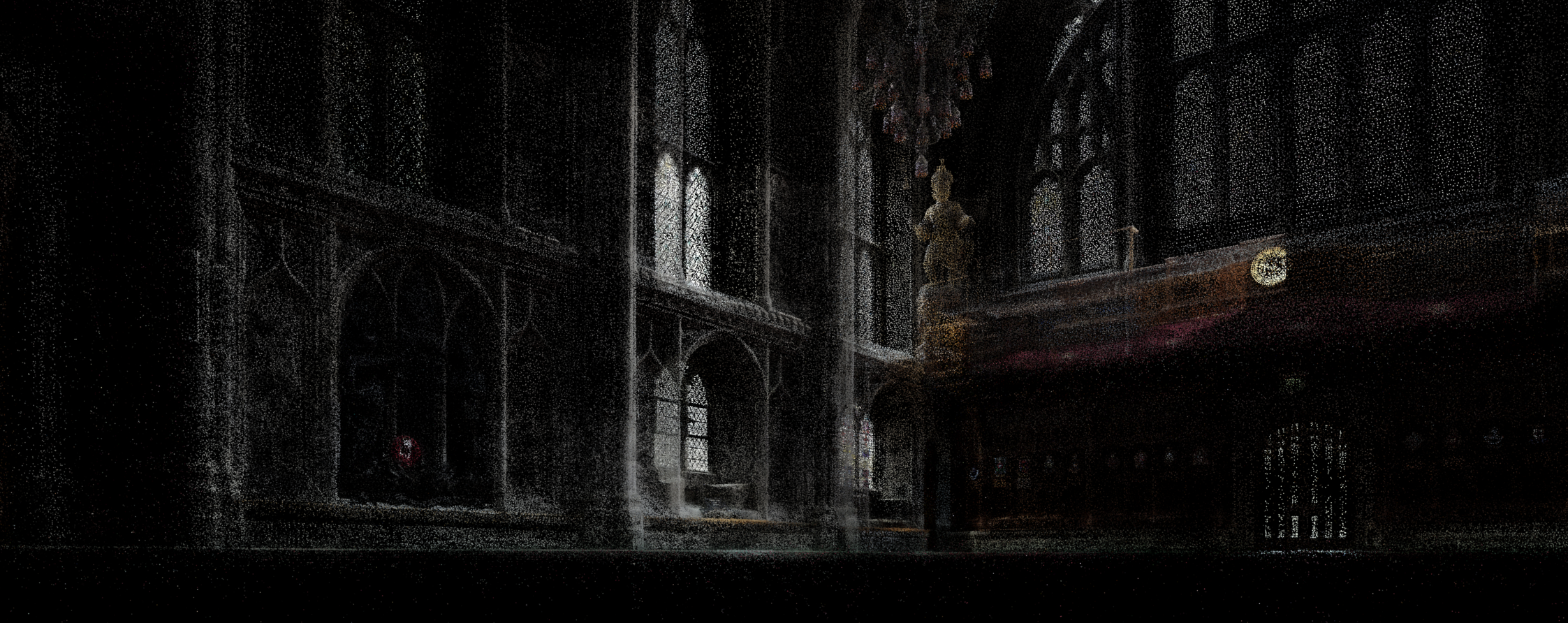
And because Teleport returns the underlying files, including the raw .PLY, Cradle of English keeps full ownership of the capture. They can bring it into whatever experience layer they choose: the presentation, the narration, the interactive points that turn a scan into a story.
From one hall to hundreds
The real unlock isn't a single beautiful capture. It's repeatability.
Teleport's pipeline has been refined across tens of thousands of captures and hundreds of billions of splats. The workflow that reconstructed the Guildhall is the same one that can reconstruct the next site, and the next hundred after that, automatically, in parallel, without adding headcount or tying up a single machine.
That changes the conversation Cradle of English can have with the institutions they work with. When a partner asks whether one scanned space could become fifty, or five hundred, the answer is no longer "if we can find the time." Cradle of English working with Teleport will find the time; and England along with its famous capital are certainly the place to prove it.
"From the printing presses of the 16th century to the 3D scanning technologies of the 21st, the challenges remain constant: pace and scaling. Working with Teleport should carry forward at pace the ambitions to realise the dreams of centuries to come." — Tam McDonald, Founder & CEO of Cradle of English
The story layer is where the magic happens
With reconstruction off their plate, Cradle of English can spend their time where it matters most: choosing which pieces of history to bring back, capturing them on site, and building the immersive experiences that let people step inside them.
Reflecting the innovation implicit in the immersive technology is the imagination with which the stories are told, embedded and linked within and across the hinterland of English history. Experience is enriched through immersion, and every opportunity is taken to encourage engagement within moments of history: what does it feel like to be there, in that place, in that moment, feeling what has been felt before by people long since gone?
Our vision is a navigable record of historic London that visitors can move through across centuries. Teleport is the 3D backbone that makes scaling that vision not just possible, but automatic.
The next chapter of cultural heritage won't be captured by hand, one painstaking reconstruction at a time. It'll be automatic.
Explore the 3DGS reconstruction of the London Guildhall for yourself on...


.png)
.png)