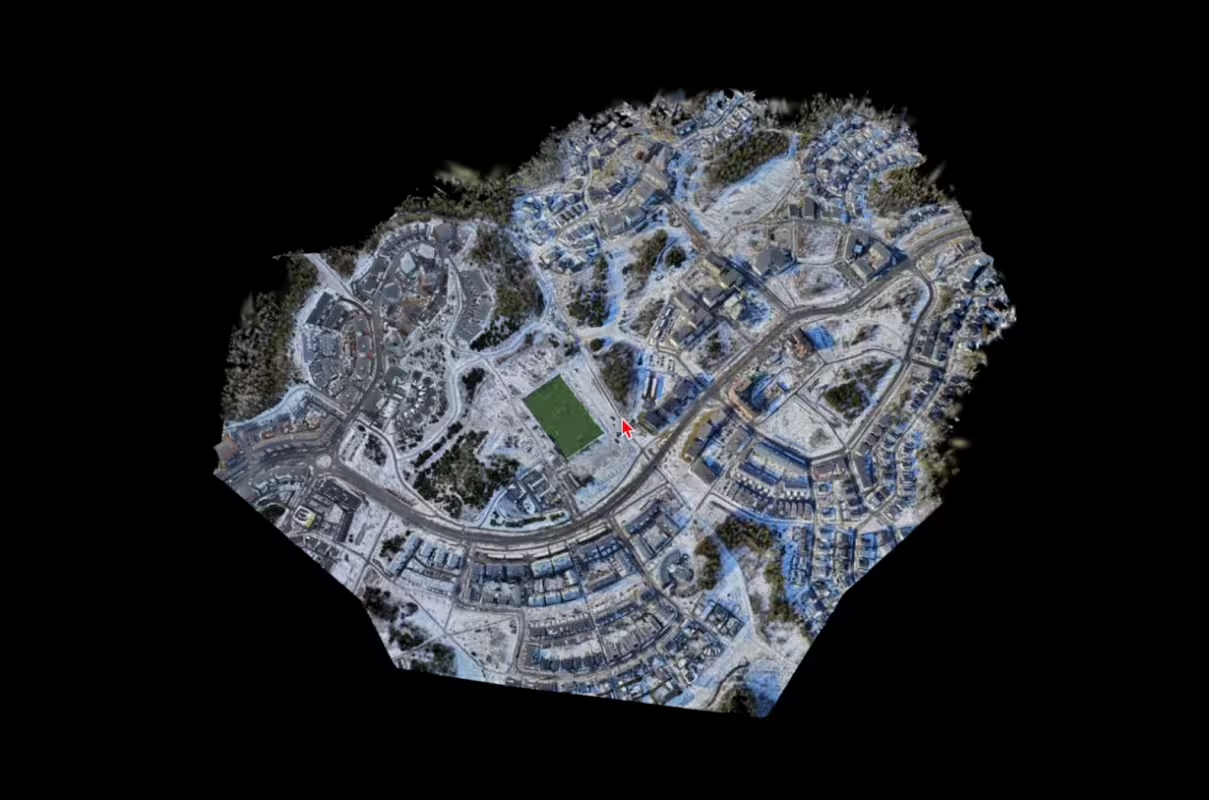
How Blurry brought automatic 3D reconstruction to its users without building a pipeline
Building a 3D Gaussian Splatting pipeline can take years. Blurry integrated Teleport's API instead, and shipped automatic 3D reconstruction to its users in a matter of weeks.
Sebastian Grigore
Blurry offered all of their users robust, reliable 3DGS reconstruction within a matter of weeks, powered by Teleport, all without pulling a two-person engineering team away from the viewer they set out to build.
A professional cloud for Gaussian Splatting
Blurry answers a question the 3D world had mostly skipped past: once you create a Gaussian Splat scene, what do you actually do with it?
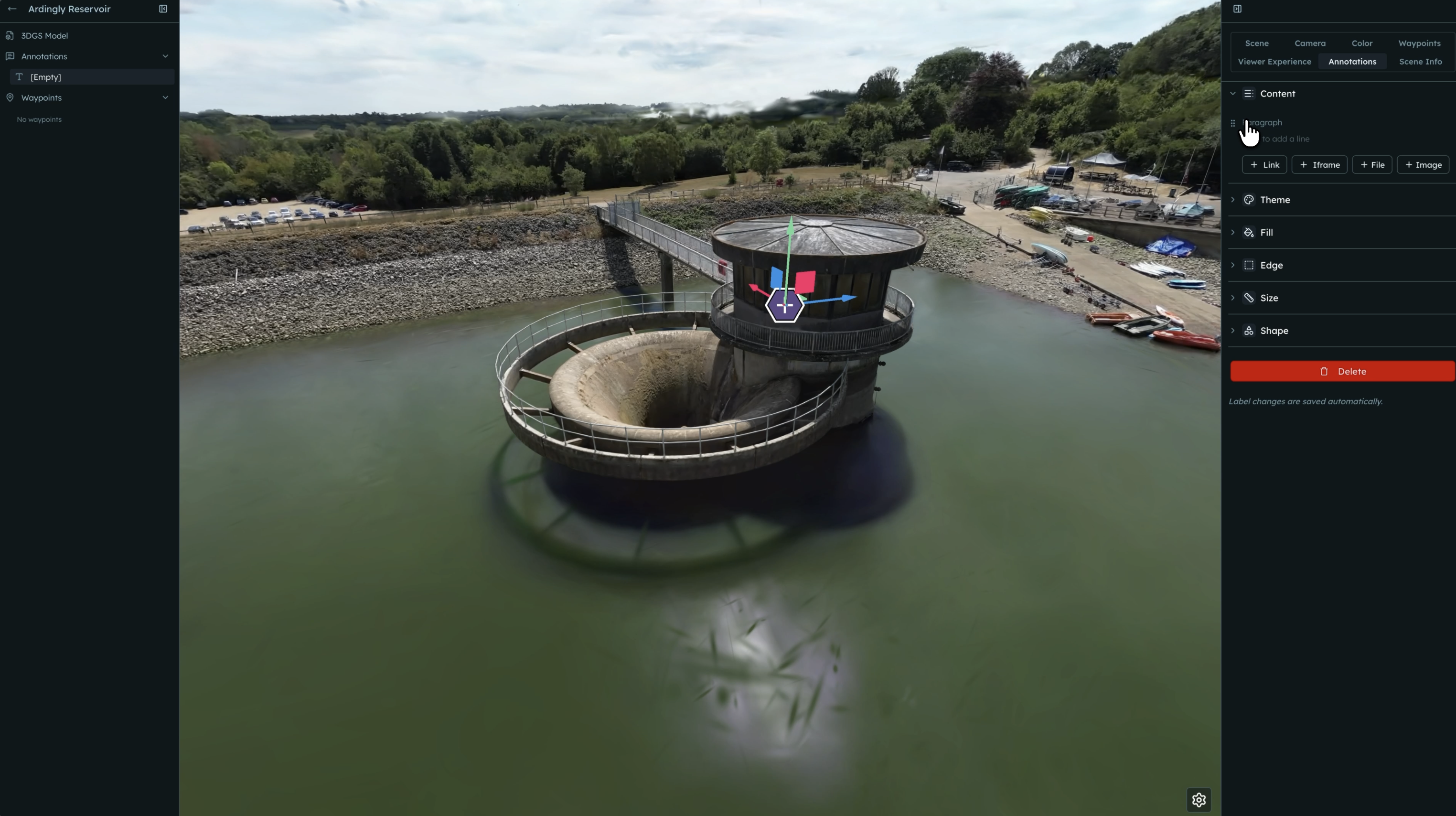
Their answer is a browser-native platform for hosting, sharing, and annotating on large 3D Gaussian Splat models. Level-of-detail streaming keeps a scan of tens of millions of splats smooth even on a phone. Annotations pin text, photos or PDFs to any point in space, turning a scan into something an entire team can read. Their users work in surveying, inspections, AEC, and cultural heritage.
Co-founders Martin Piala and Zoltán Hanesz have been deliberate about that scope. Blurry focuses on everything that happens after capture: hosting, viewing, sharing, and what you can gather out of a model. The viewer is their product, and it is where their focus goes.
Blurry's 3DGS Web Editor
Their users kept asking for the one thing they hadn’t built
There was a catch built into that scope. To use Blurry, you had to arrive with an already-created splat scene.
"The barrier of entry is that people need to come with a model already" Zoltán says. In practice, that narrowed Blurry's audience to people who already had a Gaussian Splatting workflow: hobbyists, or lone innovation champions inside larger companies. A significant & growing share of the people evaluating Blurry wanted processing built in.
Those requests concentrated in industries where reality capture is an obvious fit but Gaussian Splatting is still new. Teams in construction and surveying have the cameras, the drones and the sites. What they lack is a way to turn footage into a model. As Zoltán noted, they want to try it, but all they have is source data.
Building reconstruction in-house would have answered that, but it's a monumental task. A production pipeline has to hold up across handheld smartphone footage, drone captures and 360 camera video, each of which behaves differently, and it should run as scalable cloud infrastructure rather than a script on someone's workstation. That is a multi-year commitment for a dedicated team. Blurry is a lean team with a viewer roadmap to ship.
Why integrate instead of build
The tradeoff was straightforward. Every month spent on reconstruction was a month not spent building the features Blurry’s customers were already asking for: better streaming performance, annotations, measurements, and more. Reconstruction mattered enormously to Blurry’s users, but it wasn’t where Blurry wanted to differentiate. That made it a natural place to integrate rather than build.
Teleport fit because the hard parts were already solved. The pipeline has been refined across tens of thousands of captures and hundreds of billions of splats, helping it hold up on datasets it has never seen before. It’s hardware-agnostic, accepting images and video from virtually any RGB camera from phones and mirrorless cameras to drones and 360 rigs. It runs automatically, with no manual configuration or GPUs to provision, and returns the underlying model files, and metadata, including the raw .PLY, so Blurry retains full ownership of everything its users create.
Teleport's reconstruction parameters, configurable in Blurry's UI.
A few weeks of setup, not a few quarters of assembling & tuning
The integration came down to four steps. A user uploads images or video to Blurry, Blurry passes them to Teleport's API, a webhook fires when processing completes, and Blurry pulls the finished model straight into its own viewer. Users never leave their platform.
Zoltán requested an API key in mid-June and had the connection working by late July, fitted around everything else two founders carry. He described the build as smooth sailing, with the integration behaving much as he expected it to.
“Teleport's API was well documented and straightforward to integrate, which made adding 3DGS processing to Blurry remarkably smooth.
Across our testing, we got consistently high-quality reconstructions from a wide range of captures, whether we fed it image sets or video.” Zoltán Hanesz, Co-founder of Blurry
Reconstruction, inside Blurry
Blurry users can now upload raw footage and get a high-fidelity 3D Gaussian Splat back automatically, without leaving Blurry and without touching a single setting. From there it goes straight into the viewer, the annotations, and the sharing tools that made them choose Blurry in the first place. For their users, a barrier disappears. For Blurry, the roadmap stays theirs.
That same path is open to any platform. If your software would be more valuable with 3D capture living inside it, Teleport's reconstruction pipeline is an API call away, and the power of Gaussian Splatting creation can run natively in your own product too.


.png)
.png)
.png)